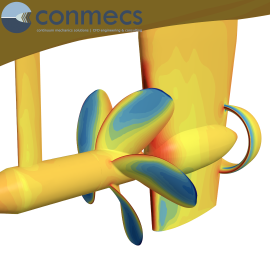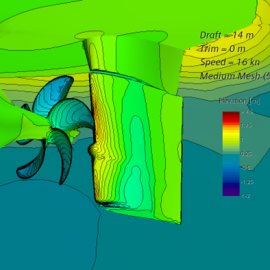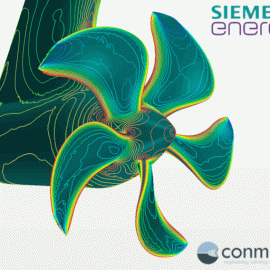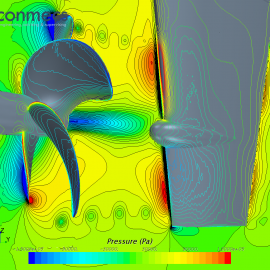
A marine propeller operating behind a vessel is exposed to a highly non-uniform and unsteady inflow. The hull, skeg, shaft and supporting structures modify the local wake field, while transient flow structures introduce additional variations in the instantaneous propeller inflow. Coupled CFD and fluid–structure interaction are used to investigate how these hydrodynamic conditions translate into individual blade loads and elastic structural response.
Bow Thruster Grid Design – Reducing Vessel Resistance through Grid Orientation

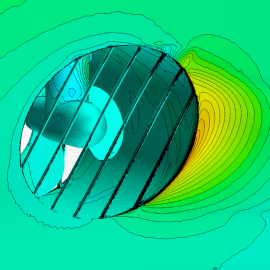
Protective grids at bow-thruster openings interact with the external hull flow and can therefore influence vessel resistance. Aligning the grid bars with the incoming flow appears to be the hydrodynamically favourable solution, as it minimises the direct resistance of the grid itself. The CFD analysis showed that the overall behaviour is governed by more than the grid resistance alone. The transverse grid orientation changed the flow through the bow-thruster tunnel and the surrounding pressure distribution, ultimately resulting in the lowest overall vessel resistance.
evolving towards a fully digital workflow
FloatModular – JRP by thyssenkrupp Carbon2Chem, INAM and ESOS Wind GmbH launched

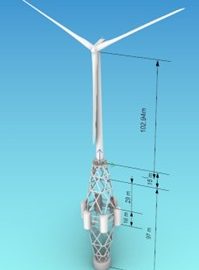
On August 1st 2024, the BMWK-funded research project FloatStructure officially started. Andreas supports ESOS Wind GmbH in the conceptual implementation of the project. It forms part of the collaborative research initiative FloatModular, which aims to develop new floating offshore wind turbine (FOWT) concepts based on a modular and scalable support structure adaptable to different water depths and turbine sizes.
investment in independent High-Performance CFD capability
To strengthen its long-term numerical hydrodynamics capability, conmecs has invested in a permanent Siemens STAR-CCM+® PowerPlus license.
BMWK-funded R&D project CableProtect started
CFD support in the BMWK-funded research project DigitShip (2022-2024)
conmecs supports Siemens Energy in R&D project

Siemens Energy Global GmbH & Co. KG is a leading global company that offers services for energy generation and transmission with a strong focus on renewable energies and solutions for the decarbonization of existing customer processes. Siemens Energy’s maritime division offers effective podded drives (PODs) for the shipping industry. Recently, Siemens Energy asked conmecs to support the CFD investigations in a R&D project.
rudder loads

The design of rudders are usually based on class society rules. The required, minimum rudder area is estimated in relation to the ship’s wetted lateral hull area. Rudder profiles come from old, successful shipbuilding projects. Rudder designs are often developed by another supplier, regardless of the propeller manufacturer. The positioning hull-propeller-rudder is traditionally based on experience from old projects.