Propeller CFD & FSI – Blade Loading & Structural Response in a Vessel Wake
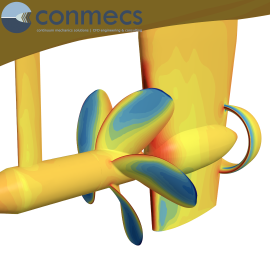
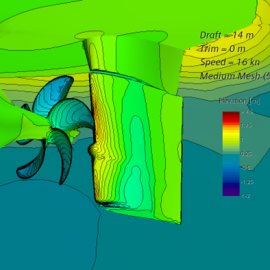
Pressure distribution on hull-propeller-rudder configuration for FSI computations

A ship propeller operates in a spatially non-uniform inflow field generated by the vessel hull, skeg and appendages. As the propeller rotates through this wake, each blade experiences continuously varying hydrodynamic loading. This full-scale showcase combines transient propeller CFD with one-way Fluid–Structure Interaction (FSI) to investigate the relationship between the vessel wake, individual blade loading and the resulting structural response. A Moving Reference Frame (MRF) solution is compared with a fully transient Sliding Mesh simulation to investigate the interaction between the propeller and the non-uniform vessel wake, from position-dependent blade loading in MRF to the transient structural response of blades

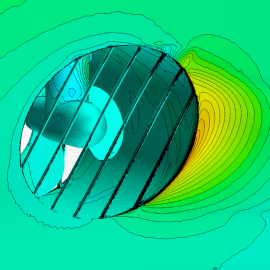
Bow Thruster Grid Design – Reducing Vessel Resistance through Grid Orientation

Bow Thruster Grid Design

Protective grids at bow-thruster openings interact with the external hull flow and can therefore influence vessel resistance. Aligning the grid bars with the incoming flow appears to be the hydrodynamically favourable solution, as it minimises the direct resistance of the grid itself. The CFD analysis showed that the overall behaviour is governed by more than the grid resistance alone. The transverse grid orientation changed the flow through the bow-thruster tunnel and the surrounding pressure distribution, ultimately resulting in the lowest overall vessel resistance.

conmecs supports Siemens Energy in R&D project

conmecs supports Siemens Energy in R&D project

Siemens Energy Global GmbH & Co. KG is a leading global company that offers services for energy generation and transmission with a strong focus on renewable energies and solutions for the decarbonization of existing customer processes. Siemens Energy’s maritime division offers effective podded drives (PODs) for the shipping industry. Recently, Siemens Energy asked conmecs to support the CFD investigations in a R&D project.

rudder loads

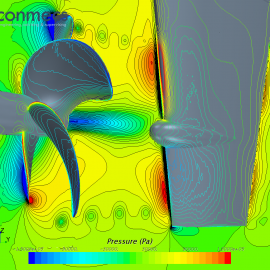
Propeller Rudder Interaction

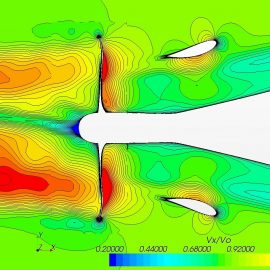
The design of rudders are usually based on class society rules. The required, minimum rudder area is estimated in relation to the ship’s wetted lateral hull area. Rudder profiles come from old, successful shipbuilding projects. Rudder designs are often developed by another supplier, regardless of the propeller manufacturer. The positioning hull-propeller-rudder is traditionally based on experience from old projects.

smoke gas propagation

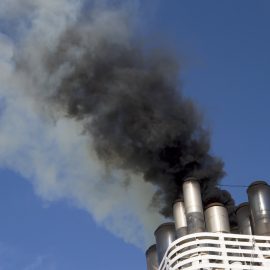
exhaust gas propagation of cruiser vessel during warm-up of engine

The exhaust emissions from ships are not only discussed in terms of GHG (greenhouse gas) reductions. The operators of offshore supply vessels (OSV) are concerned about their technical employees who work primarily on deck and are exposed to the exhaust. In addition to these health matters, yacht and cruise ship operators want to avoid that passengers be disrupted by the smell of exhaust gases.

energy saving devices (ESD)

energy saving devices (ESD)

There are a lot of different energy saving devices (ESD) on the market, e.g. pre-swirl fins, ducts (Schneekluth, Mewis), and post-swirl devices (costa bulbs, rudder fins and hub fins). The suppliers promise efficiency rates, which lie within achieved rates of former projects and the spread is often relatively high, e.g. savings of “2 up to 6%”. For ship owners it is difficult to decide, which device is the best solution for their particular ship design.