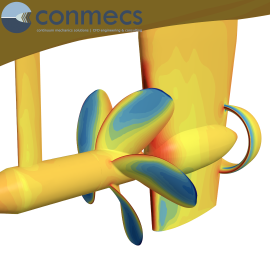
A ship propeller operates in a spatially non-uniform inflow field generated by the vessel hull, skeg and appendages. As the propeller rotates through this wake, each blade experiences continuously varying hydrodynamic loading. This full-scale showcase combines transient propeller CFD with one-way Fluid–Structure Interaction (FSI) to investigate the relationship between the vessel wake, individual blade loading and the resulting structural response. A Moving Reference Frame (MRF) solution is compared with a fully transient Sliding Mesh simulation to investigate the interaction between the propeller and the non-uniform vessel wake, from position-dependent blade loading in MRF to the transient structural response of blades
Bow Thruster Grid Design – Reducing Vessel Resistance through Grid Orientation

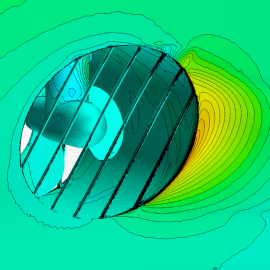
Protective grids at bow-thruster openings interact with the external hull flow and can therefore influence vessel resistance. Aligning the grid bars with the incoming flow appears to be the hydrodynamically favourable solution, as it minimises the direct resistance of the grid itself. The CFD analysis showed that the overall behaviour is governed by more than the grid resistance alone. The transverse grid orientation changed the flow through the bow-thruster tunnel and the surrounding pressure distribution, ultimately resulting in the lowest overall vessel resistance.
RANS simulations of air ventilation for AERIUS Marine GmbH
energy saving devices (ESD)

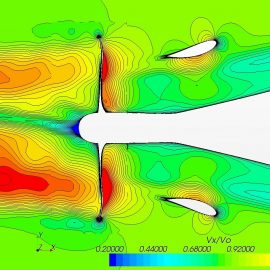
There are a lot of different energy saving devices (ESD) on the market, e.g. pre-swirl fins, ducts (Schneekluth, Mewis), and post-swirl devices (costa bulbs, rudder fins and hub fins). The suppliers promise efficiency rates, which lie within achieved rates of former projects and the spread is often relatively high, e.g. savings of “2 up to 6%”. For ship owners it is difficult to decide, which device is the best solution for their particular ship design.
reefer cargo hold ventilation

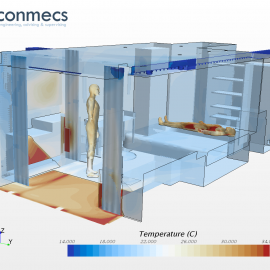
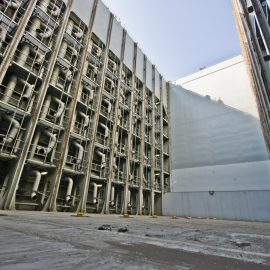
About ten years ago the proper ventilation of perishable goods was an issue for some ship owners and operators. Many reefer cargo hold ventilation systems were designed with a weak performance and the cooling units of containers failed during transport due to intake temperatures above the cooling units maximum design temperature. This problem has been solved for many container ships due to the design of ventilation systems according to new regulations, which take into account conservative fresh air volume rates.